ADHD and Weight Loss: Why Early Results Matter
If you’ve ever struggled with ADHD and weight loss, you may know exactly what it feels like to start a new diet full of enthusiasm, only to lose interest a few weeks later. Perhaps you begin with the best intentions, follow the plan carefully and feel excited about the changes you are making. But then progress slows, everyday life gets in the way, and suddenly the diet that seemed so promising becomes another thing you struggle to maintain.
You might find yourself reaching for sugary snacks when you are bored, eating without really thinking about it, or craving something that gives you an immediate sense of pleasure. You may know exactly what you need to do to lose weight, yet find it surprisingly difficult to keep doing it consistently. And when the results take longer than expected, your motivation can begin to disappear.
If this sounds familiar, I want you to understand something important: struggling with weight loss does not automatically mean you lack discipline or willpower. For some people with attention-deficit/hyperactivity disorder (ADHD), the challenges of weight management are connected to difficulties with attention, impulse control, planning and motivation.
This is one of the reasons I am so passionate about finding weight-loss approaches that work with people’s needs rather than expecting everyone to succeed using exactly the same methods.
I also have a personal connection to this subject. Although I have never been formally diagnosed with ADHD, I recognise many ADHD-like traits in myself, particularly when it comes to motivation and the importance of seeing progress. I understand how difficult it can feel to keep going when the reward seems too far away, and this is one reason I care so much about helping people find an approach that feels achievable.
Through my work as a Weight Loss Nutritionist, I have come to believe that the way a weight-loss programme delivers feedback, recognises progress and keeps someone engaged deserves much more attention. For some people who struggle with ADHD-related eating patterns, seeing early progress may make the journey feel more rewarding and help them stay motivated.
This is also why I believe the Bio Direct System® may appeal to some people who have struggled with traditional diets.
ADHD and Weight Loss – Why It Is So Much More Difficult?
ADHD affects people differently, but it can involve difficulties with executive functions such as planning, organisation, time management and impulse control. These challenges can influence everyday eating habits in ways that are not always obvious.
Think about everything a traditional diet asks you to do. You may need to plan meals, remember to buy ingredients, prepare food when you are tired, resist tempting snacks, monitor your portions and continue following the plan for weeks or months before you see substantial changes. Each task may sound simple on its own, but keeping all of them going consistently can be demanding when attention and organisation are already difficult.
Research has found an association between ADHD symptoms and certain disordered eating behaviours, particularly overeating and impulsive eating. A systematic review of 75 studies explored the relationship between ADHD and disordered eating behaviours, finding evidence of an association, particularly with overeating. Read the systematic review on ADHD and disordered eating. Emotional regulation may also play a role for some people. However, the relationship is complex, and not everyone with ADHD experiences food in the same way.
For example, one person may regularly forget to eat and then become extremely hungry later in the day. Another may snack frequently while working because food provides stimulation or breaks up a repetitive task. Someone else may find that stress and difficult emotions trigger an urge to eat, even when they are not physically hungry.
These experiences can make weight management harder, especially when a diet relies on constant planning and self-control.
The answer is not necessarily to try harder at the same thing. Sometimes, it is worth looking at whether the approach itself could be made more manageable.

Why the ADHD Brain May Prefer Immediate Rewards
One of the most interesting areas of ADHD and weight loss research concerns reward processing and delayed gratification. Some studies have found that people with ADHD are, on average, more likely to favour smaller rewards available immediately over larger rewards that require waiting. This tendency is known as delay discounting, although it varies between individuals and does not explain every difficulty associated with ADHD. A meta-analysis examining this pattern found that people with ADHD were more likely than comparison groups to choose smaller immediate rewards over larger delayed rewards. The findings help explain why delayed rewards may be challenging for some people with ADHD, although individual experiences vary. Read the meta-analysis on ADHD and immediate rewards
You can see why this might matter when it comes to weight loss.
Imagine that you have two choices. You can eat a sweet snack now and enjoy the immediate pleasure, or you can stick to your eating plan and hope to see a difference in your weight several weeks from now. The snack offers an immediate reward, whereas the benefits of your eating choices may feel distant and uncertain.
Of course, everyone experiences this kind of conflict from time to time. However, if you already struggle with delayed rewards, maintaining motivation for a goal that takes months to achieve may feel particularly frustrating.
Weight loss can make this even more difficult because progress is rarely perfectly predictable. You might follow your plan carefully for a week but see little change on the scales. You may even weigh slightly more because of normal fluctuations in water balance, hormones or digestion. Although these changes do not necessarily mean that you have failed, they can be discouraging when you are waiting for visible evidence that your efforts are working.
This is where early progress can matter.
When you see a change, it gives you feedback that your efforts may be making a difference. That can feel encouraging and make it easier to remain engaged with the process. Rather than concentrating exclusively on a distant goal, you have something more immediate to recognise and build upon.
This does not mean that everyone with ADHD needs rapid results or that slower progress is destined to fail. It means that understanding what helps you stay motivated can be an important part of choosing an approach that suits you.
Why Sugar Cravings and Snacking Can Become Part of the Cycle
Many people with ADHD describe struggling with impulsive eating, frequent snacking or cravings for foods that provide immediate pleasure. Some find themselves reaching for biscuits, sweets or other convenient foods when they are bored, overwhelmed, tired or struggling to concentrate.
Highly palatable foods can be appealing because they offer an immediate reward, while preparing a balanced meal requires planning and effort. When you are mentally exhausted, the easiest option can become the most attractive one.
However, it is important not to assume that everyone with ADHD craves sugar or that all snacking is caused by ADHD. Hunger, irregular meals, inadequate nutrition, poor sleep, stress and medication effects can also influence eating behaviour.
What matters is understanding your own pattern rather than blaming yourself for it. If you regularly find yourself reaching for food without feeling physically hungry, consider what might be happening beforehand. Have you skipped lunch? Are you tired? Are you bored or overwhelmed? Do you need a proper meal, a break or another way to manage stress?
Recognising these patterns can help you make changes that address the underlying problem rather than relying entirely on willpower.
For some people, this might mean eating more regularly to avoid becoming excessively hungry. For others, it might mean keeping convenient meals available, preparing food in advance or finding ways to make healthy eating less complicated.
The goal is not to eliminate every craving. It is to develop habits that support your health without feeling as though you have to fight yourself every day.
Why Traditional Diets Can Be So Frustrating
Many diets focus on long-term consistency. You are expected to follow the rules, make the right choices day after day and trust that the results will eventually come. For some people, that approach works well. For others, it can become exhausting.
Perhaps you begin a diet enthusiastically, but after a few weeks the novelty wears off. You become bored with the meals, forget to prepare something in advance or find that the plan requires more time and attention than you can realistically give it. If your weight then stops changing as quickly as you hoped, you may start questioning whether it is worth continuing.
Eventually, you might abandon the plan and decide to try something new. A few weeks later, you feel motivated again, so you start another diet. Over time, this repeated cycle can leave you feeling frustrated and convinced that you simply cannot stick to anything.
But what if the problem is not that you are incapable of losing weight? What if the approach you have been following makes it unnecessarily difficult for you to remain engaged?
I believe weight management needs to take real life into account. That means considering not only what someone eats, but also how much planning is required, how manageable the routine feels and whether there are opportunities to recognise progress along the way.
For someone who thrives on new challenges and visible feedback, a programme with clear stages and a defined process may feel more engaging than an open-ended diet. The key is finding an approach that helps you continue making sensible choices even when the initial excitement fades.
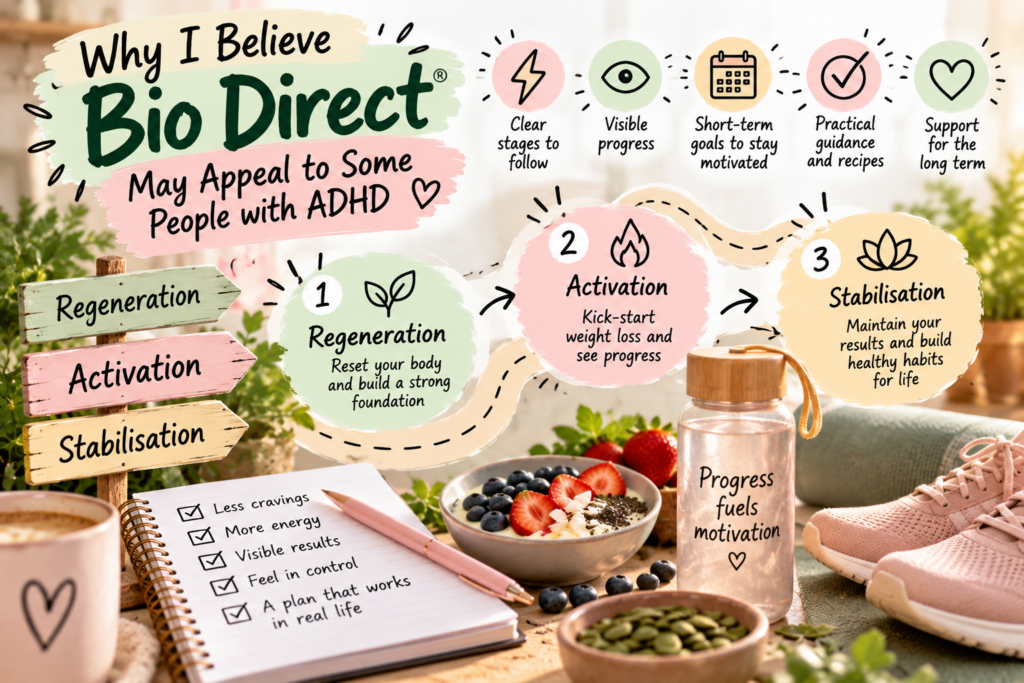
Why I Believe Bio Direct May Appeal to Some People with ADHD
This is where I believe the Bio Direct System® may be worth considering for people who find traditional weight-loss approaches difficult to sustain.
Bio Direct follows three defined stages: Regeneration, Activation and Stabilisation. The programme has a clear process rather than asking clients to follow an undefined diet indefinitely. For someone who appreciates having a specific goal to work towards, this may make the journey feel more manageable.
I also understand how encouraging it can be to see progress after putting effort into something. When changes become noticeable, they may reinforce your motivation and help you feel more confident about continuing. This is not unique to ADHD, but it may be particularly relevant for people who find delayed rewards challenging.
The way I see it, early progress can help create momentum. You begin with a goal, follow the process, see how things are changing and have a reason to keep engaging with the next stage. Instead of feeling that you are facing an endless diet, you have a clearer sense of where you are in the journey.
However, I need to highlight that the Bio Direct is a weight-management programme, not a treatment for ADHD. What I want to offer is an approach that considers the person behind the weight-loss goal and recognises that different people may need different kinds of support.
Explore the Bio Direct System®
Why Early Progress Is Only the Beginning
Although I believe early progress can be encouraging, I do not believe that quick results alone are enough to create lasting weight management.
Initial changes in body weight can include changes in water balance as well as body fat, so the scales do not tell the whole story. Weight loss also varies between individuals, and there will inevitably be periods when progress slows or fluctuates. If your motivation depends entirely on seeing the number decrease every week, you may become discouraged when your body does something perfectly normal.
This is why I believe early progress needs to be accompanied by the development of healthier habits.
The aim is to use the initial motivation as an opportunity to learn more about food, portions, protein and your own eating patterns. It is also a chance to discover which meals keep you satisfied, how to plan for busy days and how to respond when cravings appear.
These skills become particularly important when you reach the stage where weight loss is no longer the main focus.
For me, the real success of a programme is not simply how quickly someone reaches a target. It is whether they finish with more confidence around food and a better understanding of how to maintain their progress.
Why Stabilisation Matters Just as Much as Weight Loss
One of the things I want clients to understand is that reaching their goal weight does not mean they have to spend the rest of their lives dieting.
The Stabilisation stage of Bio Direct shifts the focus towards maintaining progress and developing a more sustainable way of eating. Clients receive guidance on their individual calorie requirements, portions, protein and food choices, alongside practical recipes to help them put that knowledge into everyday practice.
This stage matters because motivation can change over time. A new programme may initially feel exciting, but once the novelty fades, it is the habits you have developed that help you continue looking after yourself.
For someone with ADHD-related difficulties, having ongoing guidance during this transition may be helpful. Instead of reaching the end of a weight-loss phase and being left to work everything out alone, the focus moves towards understanding how to eat in a way that fits everyday life.
That means learning how to manage meals when you are busy, make sensible choices when eating out and return to your usual routine after an unplanned snack or a difficult day. It also means recognising that you do not need to be perfect to make progress.
A sustainable approach should work when motivation is high and when it is low. It should help you recover from setbacks without feeling that you have ruined everything.
Practical Ways to Make Weight Management More ADHD-Friendly
Whatever weight-loss programme you choose, there are practical ways to make healthy eating easier if you struggle with attention, planning or motivation.
One useful strategy is to reduce unnecessary decisions. You do not need dozens of different recipes every week. A small collection of meals you enjoy and can prepare easily may be far more helpful than an elaborate plan that requires constant organisation.
It can also help to make convenient food available before you need it. Keep suitable ingredients in the house, plan a few simple meals and prepare parts of them in advance when you have the time and energy. If cooking feels overwhelming after a long day, having a realistic backup meal can prevent one difficult evening from turning into several days of abandoning your plan.
Rather than focusing exclusively on a distant weight target, set smaller goals based on actions you can control. You might aim to eat regular meals, include a protein source at lunch, prepare tomorrow’s food in advance or follow your planned routine for the week. These give you opportunities to recognise progress even when the scales do not change immediately.
Most importantly, try not to treat a setback as proof that you cannot succeed. If you eat something unplanned or miss a meal you intended to prepare, return to your normal routine at the next opportunity. You do not need to wait until Monday or begin another diet.
Consistency is not about making every decision perfectly. It is about returning to the habits that support you.
If eating feels out of control, you experience recurrent binge eating or food is causing significant distress, appropriate professional support may be helpful. A weight-management programme alone may not address every difficulty, and you deserve support that considers your wider wellbeing.
My Personal Connection to This Subject
One reason I feel so passionately about this topic is that I recognise some of these challenges in myself. I have never been formally diagnosed with ADHD, so I would not claim to have the condition. However, I recognise ADHD-like traits in the way I experience motivation and the importance of seeing progress when working towards a goal.
I understand how frustrating it can feel to keep going when the reward seems too far away. I understand the appeal of a new challenge and how much easier it can feel to stay engaged when you can see that your efforts are making a difference.
That is one reason I care so much about helping people find an approach that fits their needs rather than constantly telling themselves they need more discipline.
I do not believe every person with ADHD needs the same weight-loss programme, and I would never suggest that Bio Direct is the answer for everyone. But I do believe that finding a programme with a clear process, visible progress and practical guidance may help some people feel more engaged in their journey.
For me, weight management should be about more than reaching a number on the scales. It should also be about understanding your eating habits, feeling more confident around food and developing healthier routines that you can realistically maintain.
Final Thoughts: You May Need a Different Approach, Not More Willpower
If you are reading this blog, it very likely that you yourself are struggling with ADHD and weight loss. I want you to know that finding traditional diets difficult does not automatically mean you lack discipline. Motivation, planning, impulse control and the way you respond to rewards may all influence your experience.
Understanding these challenges can help you choose a more realistic approach. For some people, seeing early progress may provide encouragement and help them remain engaged. For others, regular routines, practical meal planning, professional support or different strategies may be more important. There is no single solution that works for everyone.
This is why I believe it is worth looking beyond the number on the scales and considering how a weight-loss plan actually fits into your everyday life. The right approach should help you make progress without expecting perfection, while also giving you the skills to continue looking after yourself after the initial weight-loss phase has ended.
The Bio Direct System® offers a defined process through Regeneration, Activation and Stabilisation. For people who value clear stages and the encouragement of seeing progress, it may be an approach worth exploring. It is not an ADHD treatment, and I cannot promise that it will produce better results specifically because someone has ADHD. What I can do is help clients consider their individual circumstances and work towards healthier, more sustainable eating habits.
You do not have to keep repeating the same approach if it isn’t working for you. Sometimes, finding a way of doing things that fits your life better can make all the difference.
With love,
Natalia Le Sueur
Ms Calorie